
Introducing Autana Intelligence and Cassandra
A weekly model for reading Venezuela’s fragility and democratic recovery without pretending the future is simple.

There is a mountain in the Venezuelan Amazon called Cerro Autana. It rises almost straight out of the rainforest, a stone wall above the trees, known to the Piaroa people as Wahari Kuawai, the mythical tree of life, the place where earth and sky once touched and knowledge nourished the world.
On the rare days when the clouds open, Autana gives you a view that feels almost impossible. Forest in every direction. Rivers below. Distance, made visible.
We have carried that image with us for a long time. A high place. An old place. A reminder that seeing clearly is not the same as seeing easily.
That is why we named the company after it.
Why Autana exists
Autana Intelligence is an intelligence platform company, but that phrase does not say enough.
We do due diligence, organizational mapping, geospatial monitoring, predictive modeling, and strategic analysis for institutions operating in places where the truth is difficult to reach. But beneath the formal description is something more personal. Autana comes from the Venezuelan democracy struggle, where information was never abstract and where getting things wrong could carry real human costs.
Before this was a company, it was a discipline. We learned to map power inside an opaque system. We learned to verify claims in an environment saturated by propaganda. We learned to work with scarce data, hostile counterintelligence, and people whose lives depended on discretion. That history is not branding. It is the reason Autana exists.
The work is now broader. We are turning that lived experience into a next generation intelligence platform for people and institutions that need clarity on Venezuela’s transition and on other environments where official data tells only part of the story. Our team brings together people shaped by these realities with applied mathematics, machine learning, geospatial analysis, and data engineering.
The product architecture borrows from Norse mythology. Odin is the knowledge graph. Thor is the geospatial and computer vision layer. Heimdall watches media and signals around the clock. Mimir is where those streams become strategic counsel, scenario analysis, and forecasting.
The Norse language travels well in Western markets. Autana keeps us rooted at home.
Cassandra
Cassandra is the flagship product inside Mimir, and it is the reason we are writing this.
The myth has always felt close to political risk work on Venezuela. The signals are often there before the turning point. What is missing is a disciplined way to read them without wishful thinking, panic, or punditry.
Cassandra is our attempt to solve that problem. It does not claim prophecy. Politics punishes anyone who believes the future can be known too neatly. Instead, Cassandra treats uncertainty as something to measure, test, and revisit.
At its core, Cassandra is a two gauge model for regime transition. One gauge measures authoritarian fragility, meaning how close a regime is to moving from adaptation into self reinforcing breakdown. The second gauge, Atlas, measures democratic recovery, meaning whether a post transition system is consolidating, stalling, or sliding backward.
Together, they place Venezuela on a plane and track how it moves week by week.
That movement matters more than any single score. A fragility number can show when an authoritarian system is under stress, but it becomes less useful after a break has happened. Recovery has its own drivers, its own timeline, and its own risks. It deserves to be measured directly, not treated as the simple absence of dictatorship.
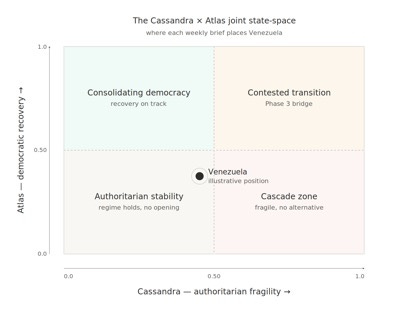
The Cassandra and Atlas state space. Each week, the model places Venezuela in one of four zones and tracks its movement across them. The position shown is illustrative.
What the model is built on
We want to explain the machinery without burying the reader in it, because the machinery is part of the credibility.
Cassandra begins with comparative politics. It draws from the literature on why authoritarian regimes survive and why they break. Milan Svolik’s work on authoritarian power sharing matters here. So does Barbara Geddes on regime types, Beatriz Magaloni on patronage and electoral autocracy, and Timur Kuran on preference falsification, the process through which private doubts can become public all at once.
The central idea is simple but powerful. Authoritarian durability is a coordination equilibrium. Regimes survive when elites, security forces, patronage networks, and outside supporters all behave as if everyone else will continue cooperating. They do not usually fall because people are angry. Anger can exist for years. They become vulnerable when people inside the system begin to doubt that the coalition will hold.
Atlas comes from a related but separate tradition. It draws on Juan Linz and Alfred Stepan on transition and consolidation, Francis Fukuyama on state capacity, and the V Dem project on democratic institutions. Recovery is not a speech, an election, or a flag raised over a building. It is the slow accumulation of institutional weight. Courts that can say no. Parties that can lose. Security forces under civilian authority. A public sphere capable of absorbing conflict without collapsing.
The statistical backbone comes from an unexpected place, quantitative finance. In 1989, James Hamilton published a model for economies moving between unobserved states, such as expansion and recession. Today we call this a hidden Markov model. The hidden state cannot be observed directly, so the analyst infers it from noisy signals and estimates the probability that the system is in one regime or another.
Portfolio managers use this family of models to read volatility cycles. Cassandra uses it to read political cycles.
On top of that regime switching layer, Cassandra adds two pieces. A logistic transition model estimates the probability of entering a cascade state in the near term. A time varying hazard model, borrowed from survival analysis, asks how the immediate risk of regime break changes as conditions evolve.
None of this makes the model omniscient. It makes the reasoning traceable. That is the standard we care about.
What Cassandra watches
Cassandra reads six weekly signals on a standardized scale from zero to one.
It watches whether the security apparatus remains reliable, whether elite bargains are holding, whether the regime can still pay and protect its dependents, how much mobilization exists in society, whether insiders still believe the center is durable, and whether external pressure is coordinated enough to shape behavior.
No single signal is enough.
Street mobilization can be absorbed if coercion remains solid. Coercive weakness may not become a crisis if society is demobilized. But when mobilization rises at the same time that coercive reliability weakens, the situation changes. Stress becomes less linear. Small events can begin to carry more force than they normally would.
That is what Cassandra is designed to capture. It does not only read the parts. It reads the interactions between them.
This is also why Atlas matters. A regime can become more fragile without a democratic alternative becoming stronger. A transition can open while recovery remains weak. A country can move from one kind of danger into another. The two gauge structure keeps those differences visible.
What Cassandra is not
Cassandra does not predict dates. It will not tell you whether a negotiation will break through by summer, whether a succession crisis happens on a Tuesday, or whether elections come in 2027 or 2030.
Anyone who claims to know that with certainty is asking you to confuse confidence with insight.
What Cassandra does is estimate probabilities and follow trajectories. It accepts that political data is noisy, contradictory, and incomplete. In the same week, sanctions signals may soften, security appointments may harden, protests may restart, and elite rumors may point in opposite directions. The model gives us a disciplined way to hold those contradictions without choosing only the evidence that confirms what we already wanted to believe.
It is also honest about its limits. The current implementation is calibrated on a short and unusual episode. It has not yet been validated out of sample. It cannot predict exogenous shocks such as an assassination, a military intervention, a sudden medical event, a natural disaster, or a black swan diplomatic reversal. Some interaction weights still reflect analytical judgment rather than learning from a large historical dataset.
Those caveats are not fine print. They are part of the product.
The humility is intentional. The Cassandra of myth was punished for seeing what others refused to believe. Ours is built to say what it sees, and also what it cannot see.
What this Substack will publish
Starting next week, we will publish the Cassandra weekly brief here.
Each brief will show the fragility score, the Atlas recovery score, Venezuela’s location on the joint plane, the movement from the previous week, which cascade interactions are quiet or active, and what the model is watching next.
We will also keep the model and the analyst visibly separate. When we write that the model reads coercive fragility at a given level, that is Cassandra speaking quantitatively. When Autana Intelligence assesses that a consolidation looks fragile, that is human judgment built on top of the model.
Both can be challenged. That is healthy.
Some weeks the numbers will move sharply. Other weeks they will barely move while the deeper state of the system changes in quieter ways. Both kinds of weeks matter. Our goal is to explain them with enough rigor for analysts and enough plain language for readers who simply want to understand where Venezuela may be headed.
From Autana’s heights, we try to see what others miss. Not because the future is fully knowable, but because disciplined uncertainty is better than confident noise.
We are glad you are here.
The first Cassandra brief publishes next Monday.
Autana Intelligence is written for investors, policymakers, operators, journalists, Venezuelans in the diaspora, and institutions that need disciplined analysis of Venezuela without confusing hope, fear, or ideology for intelligence.